
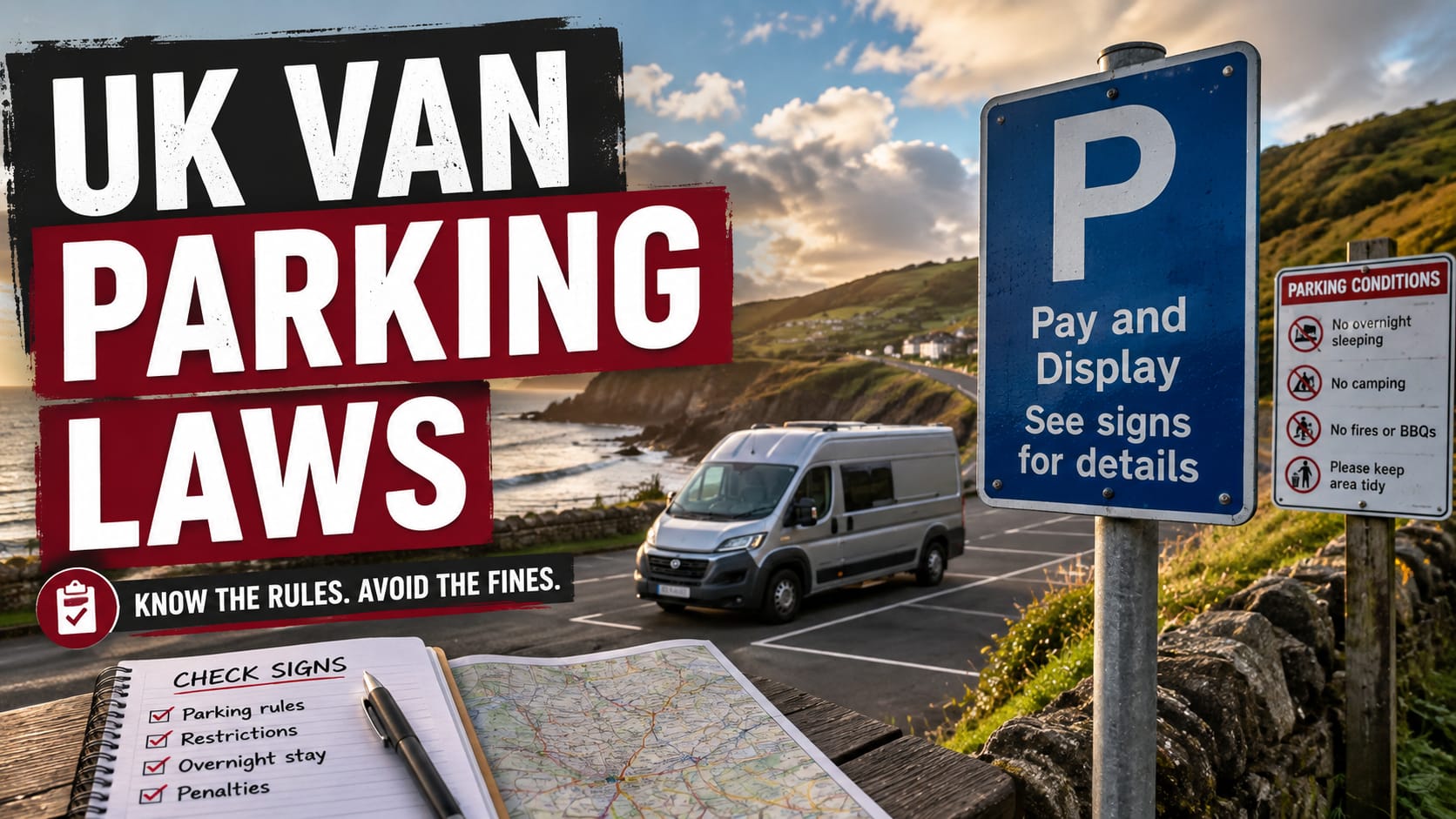
Overnight parking in the UK is one of those things that looks simple until you’re actually doing it. Find somewhere legal to park, shut the doors and go to sleep. In practice, it gets more complicated once local restrictions, private land, car park conditions and the difference between parking and camping enter the picture.
There isn’t one neat UK-wide rule that tells campervan and motorhome travellers where they can stay overnight. A spot that causes no problems in one town might be specifically restricted a few miles down the road.
The useful approach is to forget the idea of finding a universal loophole. Start with whether the vehicle is legally parked, then look for any additional restriction on staying overnight. That distinction clears up quite a lot of the confusion.
Is It Legal to Sleep in Your Van in the UK?
Sleeping in a van is not automatically unlawful. The important question is where the van is parked and what rules apply at that particular location.
You can be legally parked during the day and still be somewhere that prohibits overnight stays. Car park conditions, Traffic Regulation Orders, bylaws and other local restrictions can all affect whether you can remain there through the night.
That is why broad statements such as “it’s legal to sleep in a van” are only useful up to a point. They don’t give you permission to ignore a sign saying no overnight parking, and they don’t turn private land into somewhere you can stay without the owner’s agreement.
There is also a less obvious issue if alcohol is involved. You can potentially commit an offence by being in charge of a vehicle while over the legal alcohol limit without actually driving it. Whether somebody is considered to be in charge depends on the circumstances, so sleeping in the van after a few drinks should not be treated as an automatic workaround to drink-driving law.
Overnight Parking on Public Roads
Parking on a public road overnight can be perfectly lawful, but the usual road and parking rules still apply. Your van needs to be road legal, you must not cause an obstruction or hazard, and you need to comply with whatever restrictions are in force where you stop.
That might mean yellow lines, residents-only bays, controlled parking zones, clearways, limited waiting periods or a local restriction aimed specifically at overnight motorhome or campervan parking.
One easily missed detail is lighting. On roads and lay-bys with a speed limit above 30mph, parking lights are required at night. On slower roads, the exemptions depend partly on the vehicle and how it is parked, so it is unwise to assume a larger or heavier van is treated exactly like a small car.
Local overnight controls do not all arrive under the same label either. Councils can use Traffic Regulation Orders, off-street parking orders, bylaws and, in some circumstances, Public Spaces Protection Orders. In practical terms, this means there is no single type of sign to look for across the whole country.
Read the restrictions where you are actually parking. If an authorised officer tells you the van cannot remain there, arguing the finer points at midnight is unlikely to rescue the evening.
Can You Sleep Overnight in a Car Park?
Car parks are where assumptions get expensive. Some permit overnight parking, some allow vehicles to remain but prohibit sleeping or camping, and others close completely after a certain time.
Many council and privately managed car parks also have maximum stays or restrictions affecting larger vehicles. Some have height barriers, while individual sites can also impose vehicle length, weight or bay-use conditions.
The absence of a barrier tells you almost nothing about whether an overnight stay is allowed. Check the entrance boards and payment signs for closing times, overnight restrictions, maximum stays and any wording that applies specifically to campervans or motorhomes.
Private car parks need the same attention. Enforcement there will normally involve a Parking Charge Notice rather than a council-style fine. The parking terms should be made clear on the signage, so read what is actually displayed before assuming that a quiet corner of an empty car park is fair game.
Wild Camping, Remote Parking and Private Land
Parking beside open countryside is one of the more attractive parts of travelling by van. It is also where the difference between wild camping on foot and sleeping in a vehicle matters most.
In England, Wales and Northern Ireland, there is no general right to take a motor vehicle onto somebody else’s land and stay there overnight without permission. Somewhere looking remote does not make it unowned.
Scotland is often misunderstood here. Scottish access rights are much broader for people travelling on foot, but they do not create a general right to park or camp in a motor vehicle. If a Scottish road trip involves remote overnight stops, the Scottish Outdoor Access Code is worth reading before you go rather than relying on the usual “wild camping is legal in Scotland” shorthand.
Loch Lomond and The Trossachs is a good example of why local rules matter. Camping bylaws operate within designated Camping Management Zones and permits are required at certain locations. For its assigned motorhome and campervan permit bays, the National Park currently advises space for vehicles of roughly 8 metres long by 2.5 metres wide, although you should still use the details for the individual permit area rather than treating that as a universal size allowance.
Worth remembering: leaving no trace isn’t just good ethics. A quiet overnight stop that leaves nothing behind gives residents and landowners far less reason to object to the next van that arrives.
Lay-Bys and Motorway Services
Lay-bys are useful when you need a rest and some can be used for overnight parking, but there is no blanket rule making every lay-by suitable for a night in the van.
Normal road-parking rules still apply, along with any restriction shown at the site. The night-time lighting rules apply here too, so the speed limit on the road and the type of vehicle you are driving matter.
Motorway services are less romantic but considerably less ambiguous. In England, signed motorway service areas provide at least two hours of free parking. Stay beyond that and charges can apply, with the amount and permitted duration varying between operators and sites.
Check the signs when you arrive rather than trusting a price mentioned in an old forum post. Service areas are generally well lit and monitored, with toilets, food and fuel nearby. It’s not the most scenic option, but sometimes practical wins.
What About Stealth Camping?
Stealth camping is usually used to describe sleeping quietly in a van in an urban or suburban area without attracting much attention. For some van travellers it is a practical necessity rather than a preference.
The word “stealth” can make the whole thing sound more sophisticated than it is. Being discreet does not make restricted parking legal.
Start with somewhere you are actually permitted to park. From there, keeping your impact low is simply considerate: avoid blocking houses and access points, keep noise down, don’t spread chairs or cooking equipment onto the pavement and leave nothing behind when you go.
If the plan depends on nobody noticing that you are breaking a clearly displayed restriction, it is probably time for a different plan.
Dedicated Motorhome Stopovers and Britstops
Dedicated stopovers are useful because they remove much of the guesswork. Instead of wondering whether an ordinary car park tolerates vans overnight, you are using somewhere intended for that purpose.
Britstops is one of the best-known UK schemes. Membership gives access to a large network of participating pubs, farms, vineyards, breweries and other independent businesses across the UK and Ireland.
Hosts provide a no-fee overnight stop through the scheme. Buying a meal, drink or something from the business is encouraged rather than required, although supporting the place that has given you somewhere to stay seems a fairly reasonable trade.
Britstops uses self-contained motorhome requirements, so check the current eligibility conditions before joining rather than assuming every van conversion qualifies automatically.
Vehicle size is also worth checking at individual stops. The Britstops app can filter by vehicle length, and host listings can include a maximum vehicle size and the number of available parking spaces. If you are driving something long, that is far more useful than knowing the scheme accepts motorhomes in general.
Facilities vary by host. Some locations offer additional services, while others provide little more than a legitimate place to stop for the night. Unless the listing says otherwise, treat a Britstops location as a stopover rather than a campsite.
There are also council and privately operated motorhome stopovers or aires in parts of the UK. They remain less common than across countries such as France, but where they are available they can make route planning considerably easier.
Apps for Finding Overnight Campervan Parking
Overnight-stop apps have made road-trip planning much easier, although they have also created a new problem: people treating a map pin as permission.
Park4Night is one of the largest options, with more than 370,000 locations listed worldwide and plenty of UK coverage. Listings include everything from parking areas and lay-bys to campsites, aires, pub stops and paid overnight locations.
The photographs and recent comments are often the most useful part. A description written two years ago might say a car park is unrestricted, while somebody who stayed last week may have photographed a new barrier or sign.
The basic Park4Night service is free, with paid features available for people who want additional filters and offline use.
Campercontact is another useful option and tends to lean more towards recognised motorhome stopovers and campsites. Its network now covers tens of thousands of locations internationally, making it particularly handy for trips that continue beyond the UK. Paid options include offline features.
Search for Sites is also useful for UK and European campsites and stopovers. Running more than one app can make sense when you are somewhere unfamiliar, particularly if the information on one listing is old.
None of these apps overrides the rules on the ground. Restrictions change, sites close and user reports can be wrong. Treat the apps as a way of finding possibilities. If the sign in front of you says something different, the sign wins.
Does DVLA Motor Caravan Classification Affect Overnight Parking?
Not directly. Having “motor caravan” written on the V5C does not give you a special right to sleep somewhere that otherwise prohibits overnight parking.
The classification still matters enough to understand, particularly if you are converting a van yourself. You can apply to the DVLA for a converted vehicle to have its body type recorded as “motor caravan”, but the vehicle needs to meet the relevant criteria.
Those requirements cover the living conversion itself, including sleeping, seating, cooking and storage arrangements, as well as external appearance. Current external criteria include windows, separate access to the living accommodation, motor-caravan-style graphics, an awning bar and a high-top roof.
If reclassification is part of your build plan, read the current DVLA criteria before designing the van around assumptions picked up from older conversion guides. Meeting the conversion requirements and the DVLA deciding to record the vehicle as a motor caravan are not quite the same thing.
A converted vehicle can still be used as a motor caravan even if the DVLA leaves a different body type on the V5C. At the same time, vehicle keepers are responsible for notifying relevant changes to the DVLA. It is therefore more accurate to think of the process as reporting the conversion and allowing the DVLA to decide how the body type is recorded, rather than saying reclassification is simply optional.
The wording on the V5C should not be treated as an automatic route to cheaper insurance or a different MOT either. The DVLA body description does not itself determine the vehicle’s insurance category, and MOT classification follows separate rules. Your insurer needs to know what the vehicle actually is and how it is being used.
Clean Air Zones add another layer. Campervans and motorhomes can be treated differently depending on the particular zone, vehicle emissions and the details recorded against the registration. There is no general rule that a vehicle described as a motor caravan is automatically exempt, so use the official checker for the area you are entering.
Seasonal Overnight Parking Restrictions
A legal overnight stop in March is not guaranteed to remain one in August.
Coastal and rural destinations become busier during the main holiday season, and pressure around campervan parking can increase with them. Councils can respond with seasonal controls, height barriers or Traffic Regulation Orders affecting particular roads and car parks.
North Yorkshire provides a recent example. Experimental overnight motor-caravan restrictions were introduced at specified coastal locations in late 2024. In March 2026, North Yorkshire Council approved a permanent Traffic Regulation Order for the affected locations, with the decision taking effect in April 2026.
For anyone planning a road trip, the lesson is more useful than the individual example: don’t assume last year’s overnight stop still works.
Check the council information for places where overnight van parking is contentious, then compare it with what you find when you arrive. Recent community-app reports are useful for spotting changes, but they remain secondary to official restrictions and the signs on site.
There’s usually somewhere quieter nearby.
Respect the Places You Park
A van takes up a parking space. A van with chairs, an awning, rubbish bags and a barbecue spread around it has started doing something rather different.
Most of the basic etiquette is not complicated:
- Don’t block driveways, gates or access points.
- Keep noise down, particularly late in the evening and early in the morning.
- Only put out chairs, awnings or cooking equipment where that kind of use is actually permitted.
- Take all rubbish with you.
- Use local businesses where it makes sense to do so.
Restrictions are often introduced because councils and residents are responding to repeated problems rather than the mere existence of campervans. That does not mean every restriction is well designed, but it does mean inconsiderate behaviour has consequences for everyone travelling afterwards.
The Simplest Way to Think About UK Van Parking Laws
The rules around overnight van parking can look messy because there is no single national system covering every road, car park and piece of land. Once you stop looking for one universal rule, it becomes easier to deal with.
First, make sure the vehicle itself is legally parked. Then check whether staying overnight is restricted separately. Read the signs, pay attention to vehicle-size or access limits if you are travelling in a larger van, and remember that an app recommendation is not permission.
For longer road trips, keep more than one potential stop in mind. A car park can fill, a barrier can appear, or a restriction can change without your favourite app catching up immediately.
Most of the time, sensible route planning and a bit of consideration remove the drama. Park where you are allowed to park, keep your impact small, leave the place as you found it and move on if the rules say the night needs to happen somewhere else.