
If you are driving through France in a car, van or campervan, speed limits are one of those things worth getting straight before you set off. One thing I have found is how quickly the limit can change as you pass through towns and villages, so relying on the number you remember from a few miles back is an easy way to get caught out.
The rules also change with the type of road, the weather and, for heavier vehicles, the vehicle itself. Add several different types of speed enforcement into the mix and it pays to know what to expect. The aim here is simple: help you understand the main French speed rules and make a fine-free journey a little easier.
Understanding Speed Limits in France
For most cars and lighter vans or campervans, the general French speed limits are:
- Built-up areas: generally 50km/h, although signed 30km/h zones and other lower local limits are common.
- Roads outside built-up areas: generally 80km/h unless a different limit is signed.
- Roads with physically separated carriageways: up to 110km/h.
- Motorways: up to 130km/h.
Some individual road sections may have a different signed limit, including sections where 90km/h is permitted, so the road signs in front of you always matter more than a general table.
Speed limits in rain
Rain brings lower maximum speeds. On roads normally limited to 130km/h, the maximum falls to 110km/h. On separated carriageways normally limited to 110km/h, it falls to 100km/h. Other roads covered by the national rule are limited to 80km/h.
There is another weather rule that is easy to miss. When visibility falls below 50 metres, the maximum speed is 50km/h across the road network, including motorways. A lower posted limit still takes priority.
New drivers and French probationary licences
France has lower maximum speeds for drivers covered by its probationary licence rules: 110km/h on motorways, 100km/h on roads with separated carriageways and 80km/h on other roads.
It is better not to treat this simply as a rule for every “newly qualified driver”. If you hold a foreign licence and have only recently passed your test, check how the French rules apply to your particular licence rather than assuming the UK definition maps directly onto the French system.
Driving a van or motorhome over 3.5 tonnes
If your van, campervan or motorhome has a permitted gross weight above 3.5 tonnes, do not assume the ordinary light-vehicle limits apply. Heavier vehicles are subject to separate rules, with limits including 90km/h on motorways, 80km/h on many other roads and 50km/h in built-up areas, subject to the vehicle’s classification and any specific exceptions.
This is one of those details that is particularly important for larger motorhomes. Check the registered weight and category of your own vehicle rather than judging it by size alone.
Speeding Fines: What to Expect
The fine depends on how far over the limit you are and, for smaller excesses, what the speed limit was on that road.
- Less than 20km/h over where the limit is above 50km/h: normally a third-class offence with a fixed fine of €68.
- Other speeding offences below 50km/h over the limit: normally a fourth-class offence with a fixed fine of €135. A reduced €90 amount can apply when the fine is eligible and paid within the required period.
- 50km/h or more over the limit: this became a criminal offence in France from 31 December 2025. It can carry a fine of up to €3,750, up to three months’ imprisonment and additional sanctions.
The important distinction with that first category is the posted speed limit, not simply whether you are inside or outside a town.
Speed Cameras in France: What You Need to Know
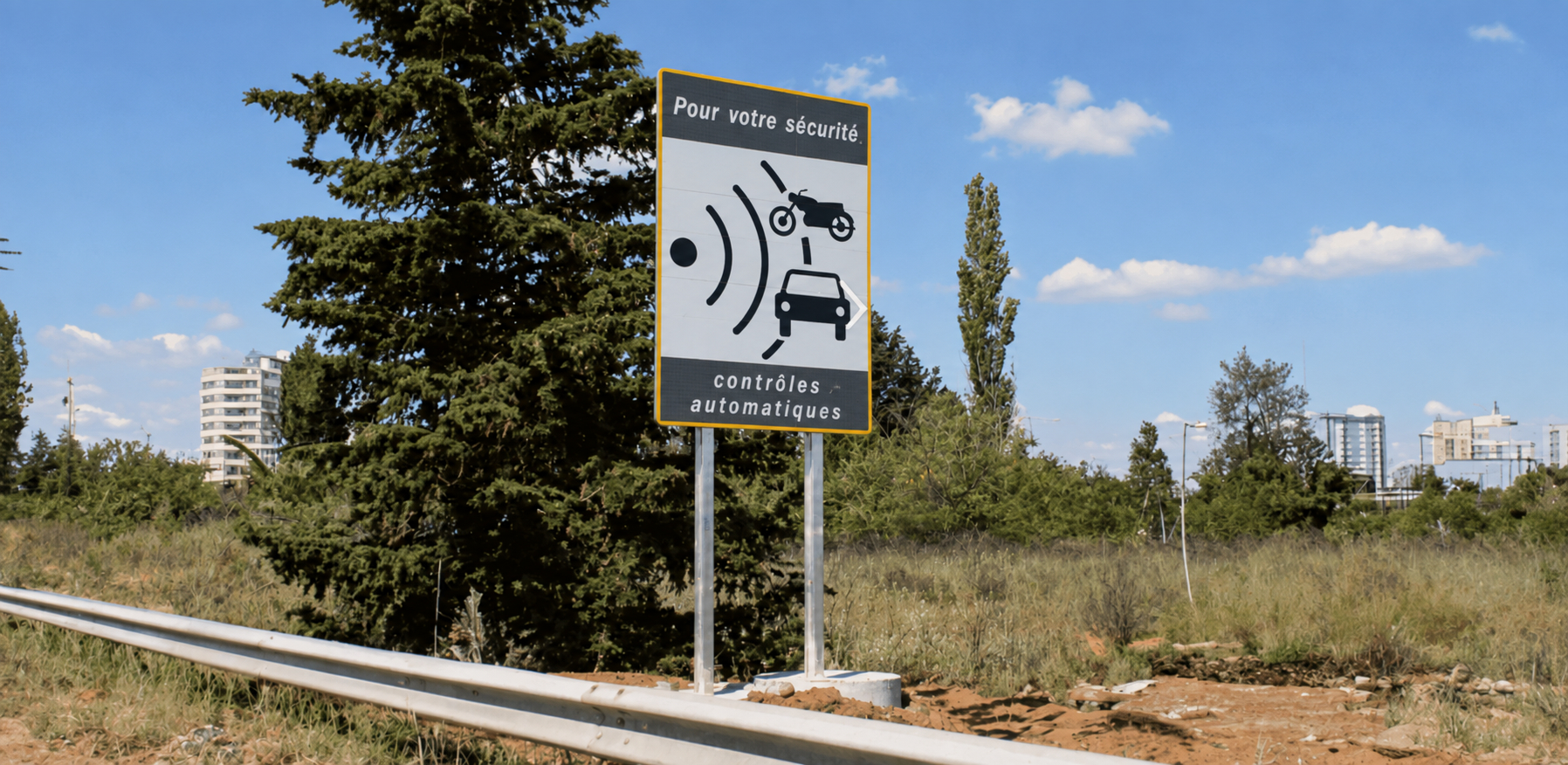
French roads use several forms of speed enforcement, including fixed cameras, mobile enforcement and average-speed systems. You should not rely on spotting a camera or seeing a flash to tell you whether your speed has been recorded.
Do French speed cameras flash?
Some cameras may produce a visible flash, but that is not a dependable guide. Mobile radar vehicles can use infrared equipment that operates without a visible flash, so driving past without seeing anything does not mean you have not been recorded.
The speed-camera margin is not a free allowance
You will sometimes hear people talk about a 5% “tolerance” on French speed cameras. It is better understood as a technical measurement margin rather than permission to drive over the limit.
For fixed radar, the measurement margin is 5km/h at speeds below 100km/h and 5% at speeds above 100km/h. Radar used from a moving vehicle has a larger technical margin of 10km/h below 100km/h and 10% above it.
That margin exists to account for measurement accuracy. It is not something I would build into the way I drive.
Speed-camera detectors
Using prohibited speed-camera detection or location equipment in France can have serious consequences. The device itself can be confiscated, and vehicle confiscation can also apply where prohibited equipment has been fitted, adapted or applied to the vehicle.
That distinction matters because the law is more specific than simply saying every detector offence automatically leads to the vehicle being confiscated.
Navigating Speed Enforcement with Technology
Navigation apps can still be useful in France, but it is worth understanding what they actually show rather than assuming they will pinpoint every camera.
Waze
Waze handles French speed enforcement by warning about broader control zones rather than giving an exact camera position. That matches my own experience of using it: the alert has been for a control zone, not a pin dropped on the precise camera location.
It is useful as an extra prompt to pay attention, but the safest approach is still to follow the posted limit rather than treat an app as a camera-finding tool.
Apple Maps
Apple Maps currently provides features such as incident reporting and speed-limit information in France, but France is not listed among the countries where Apple’s Speed Cameras feature is available.
App features do change, so use technology wisely and treat the signs on the road as the thing that matters.
One More Driving Rule to Remember: Crit’Air
Speed cameras are only one part of driving legally in France. Crit’Air stickers are required for vehicles circulating or parking in designated French low-emission zones, known as ZFE-m, and can also be required when temporary pollution restrictions are in force.
That does not mean you automatically need a Crit’Air sticker simply because you drive into any French city centre. Check the requirements for the places on your route before travelling.
A Calmer Way to Drive Through France
The easiest way to stay on the right side of French speed rules is not to memorise every camera location. Know the general limits, expect them to change through towns and villages, watch the signs, and remember that rain, poor visibility and a vehicle over 3.5 tonnes can all change what applies to you.
Navigation apps can be helpful, but they are best used as another source of awareness rather than something to rely on for enforcement locations. Keep an eye on the road in front of you, check the rules that apply to your own vehicle, and you can spend more of the journey thinking about where you are going rather than whether a fine is following you home.