
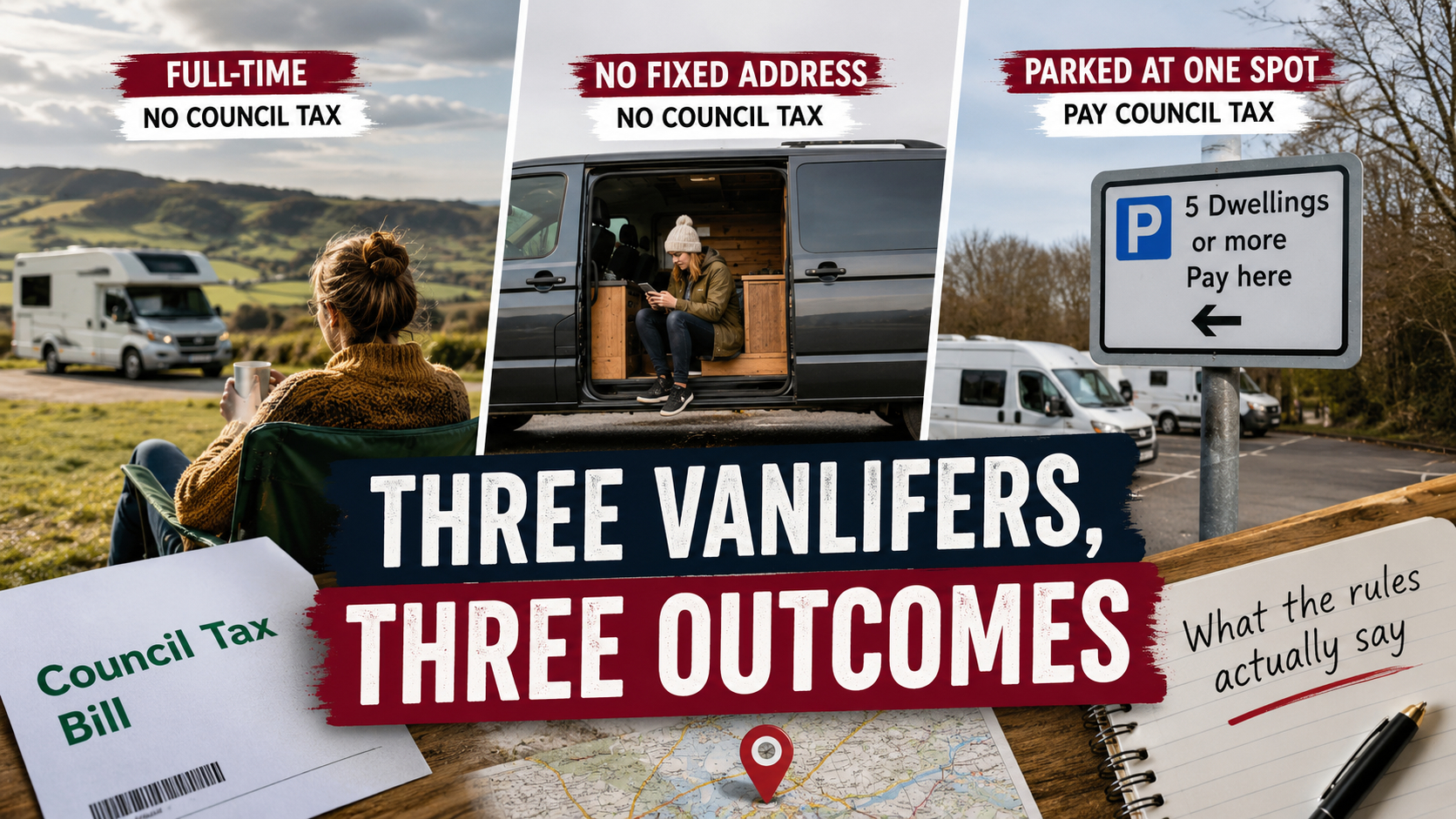
One of the biggest draws of vanlife is the sense of freedom. No rent, no fixed address and no daily commute. But that freedom does not automatically mean freedom from bills, and one of the most common questions I hear from new and aspiring vanlifers is this: do you have to pay Council Tax if you live in a motorhome?
The short answer is usually no if you are travelling rather than living on an established pitch, but it depends on how and where you live in your motorhome.
There is also an important UK distinction. Council Tax applies in England, Scotland and Wales. Northern Ireland has a different system based on domestic rates, so the Council Tax rules discussed below are mainly relevant to Great Britain.
If you are travelling full-time and not based on an identifiable pitch that functions as your sole or main home, Council Tax will generally not be an issue. If your motorhome is settled long-term on a residential site or private land, things can become more complicated.
What Is Council Tax and Why Does It Matter?
Council Tax is a local charge used to fund services such as rubbish collection, street lighting, libraries and other council services. It applies to domestic dwellings, which can include some caravans and motorhome pitches as well as conventional houses and flats.
The important point is that living in a motorhome does not automatically create a Council Tax bill, but neither is a motorhome automatically outside the system simply because it is a vehicle.
In England and Wales, the Council Tax rules around caravans can include motor vehicles designed or adapted for human habitation. What matters is whether there is an established pitch that is being occupied as someone’s sole or main residence. In Scotland, caravans occupied as a main residence can also count as dwellings for Council Tax purposes.
That is why normal touring rarely causes a problem. The grey area begins when the arrangement starts looking less like travelling and more like having a settled home on a particular piece of land.
Mobility still matters in practice, but it is not a magic test. A motorhome can leave a pitch from time to time and that pitch may still remain part of a settled residential arrangement.
When You Do Not Need to Pay Council Tax in a Motorhome
In most ordinary touring situations, a separate Council Tax charge is unlikely to apply.
- Full-time travellers: If you are regularly travelling, moving between campsites, CLs and different stopping places rather than occupying an established pitch as your sole or main residence, you are not living in one Council Tax dwelling in the same way as someone settled on a residential pitch.
- Short-term camping: A normal stay on a campsite or stopover will not usually make that pitch your Council Tax residence. You are using it as part of your travels rather than establishing it as your home.
- Temporary living: Simply sleeping in a motorhome for a few weeks or months while travelling or between homes does not automatically create a separate Council Tax liability. The circumstances can be different if a defined pitch effectively becomes your sole or main residence, though, so “temporary” on its own is not an exemption.
For most people travelling in this way, the regular costs are much more likely to be fuel, insurance, MOT, vehicle tax and campsite fees than a separate Council Tax bill for the motorhome.
When You Might Need to Pay Council Tax
There are situations where Council Tax can come into play, particularly when the motorhome has an established base that is being used as your sole or main home.
Permanent Pitch on a Residential Site
If you live year-round on an established pitch and the motorhome is your sole or main residence, the pitch may be entered into the Council Tax valuation list. In practice, that can mean Council Tax becoming part of the cost of living there, much as it would with a more conventional home.
It is not simply the fact that the site calls itself “residential” that decides the Council Tax position. How the pitch is occupied and whether it is being used as someone’s main residence are important.
Motorhome Parked on Private Land
If your motorhome is stationed long-term on your own land or somebody else’s and is being used as your main home, Council Tax may become relevant.
Planning permission and Council Tax are two separate questions here. Living permanently in a motorhome on private land can create planning or site-permission issues, but the planning status does not by itself decide whether a pitch should be treated as a Council Tax dwelling.
In other words, it is worth checking both rather than assuming that sorting one automatically sorts the other.
Converted Motorhome Used as a Fixed Dwelling
Some self-build vans are registered as motor caravans with the DVLA but spend most of their time in one place. The vehicle’s registration does not settle the Council Tax question on its own.
If the motorhome is being used as a sole or main residence on an established pitch, that arrangement can potentially be treated as a dwelling. Moving the van away occasionally does not necessarily change that if the pitch is effectively reserved as its home base.
The useful distinction is not simply “the land is taxed and the motorhome is not”. Depending on the circumstances, the pitch may be what is banded, while a sufficiently permanent caravan or motorhome can also form part of the valuation.
What About Using a Friend’s or Family’s Address?
A lot of vanlifers handle the practical side of paperwork by keeping a correspondence address with family or close friends. It can be a straightforward way of dealing with post while spending most of your time on the road.
- Your driving licence or other documents use a family address
- Your bank or other providers send post there
- You live mostly on the road in the van
- The property already has its own Council Tax account
Using an address for correspondence does not, by itself, create a second Council Tax bill for you. However, I would not assume that the household’s Council Tax position can never be affected either.
Councils look at where someone is actually resident, particularly when things such as a single-person discount are involved. A postal address and a sole or main residence are not necessarily the same thing, so the circumstances matter.
You do not necessarily need a friend’s or relative’s address purely to stay registered to vote either. In England, Scotland and Wales there is an official registration route for people who do not have a fixed or permanent address.
Practical Advice for Motorhome Dwellers
From speaking with other vanlifers, campsite owners and a couple of council officers over the years, a few practical patterns come up again and again.
- Staying mobile usually keeps things simpler: Regular touring normally means you are not occupying one established pitch as your sole or main home. Just remember that moving the van occasionally is not, by itself, a Council Tax exemption.
- If you want to settle, check both sides of it: Long-term motorhome living on a particular piece of land can raise planning questions as well as Council Tax questions. They are related in practice, but they are not the same thing.
- Keep your admin in order: DVLA documents, insurance companies and banks have their own address requirements, so make sure the details you give them are accurate. Healthcare is not quite as simple as needing a permanent postal address for everything. In England, for example, you can register with a GP without having a permanent address.
- Check whether a settled pitch is already listed: England and Wales have an official Council Tax valuation-list search, while Scotland uses the Scottish Assessors system. If you are considering a long-term pitch, checking its existing status is a useful starting point. Northern Ireland uses the separate Land & Property Services rates system.
- Be realistic about how you live: If the van is genuinely part of a travelling lifestyle, Council Tax is rarely an issue. If it has effectively become your settled home on an identifiable pitch, expect the position to need a closer look.
Examples from the Road
Touring couple: A pair I met in Cornwall had been travelling full-time for two years. They used her sister’s address for post, rarely stayed anywhere longer than a few weeks and had never had any Council Tax issues.
Static motorhome on farmland: Another vanlifer in Devon had parked on his uncle’s land. Once the council became aware of it, planning permission had to be addressed first. After that, the land was banded for Council Tax. It is a useful reminder that the planning and Council Tax questions are separate, even though both can arise from the same living arrangement.
Residential site living: Friends of mine live permanently on a licensed residential park in their motorhome and pay Council Tax in the same way as other site residents. It is still vanlife, just a much more settled version of it.
Those are individual examples rather than rules, but they show why two people who both say “I live in a motorhome” can end up with very different Council Tax situations.
So, Do You Have to Pay?
Put simply:
- Usually no if you are genuinely touring and are not occupying an established pitch as your sole or main residence.
- Potentially yes if your motorhome is your sole or main home on an identifiable, established pitch.
- Moving the motorhome does not decide the issue on its own. A pitch can remain relevant even if the vehicle occasionally goes away and returns.
- Planning permission and Council Tax are separate issues. Do not assume the answer to one automatically answers the other.
A useful way to think about it is this: the more your setup starts to resemble a settled home on a particular pitch, the more likely Council Tax becomes relevant.
For most full-time travellers who are genuinely moving around, it is rarely something that causes problems in practice. If you are planning to settle somewhere long-term, check the pitch’s valuation status and speak to the relevant council or assessor before you commit.
If you are in Northern Ireland, remember that the system is different and you will need to look at domestic rates rather than Council Tax.
Have you had any experience with Council Tax and motorhome living? Drop a comment below. I would genuinely like to hear how it worked in real life, as these situations often vary more in practice than people expect.
If this helped, have a look at our other guides on vanlife costs, planning your first long trip and the practical realities of living on the road full-time.