
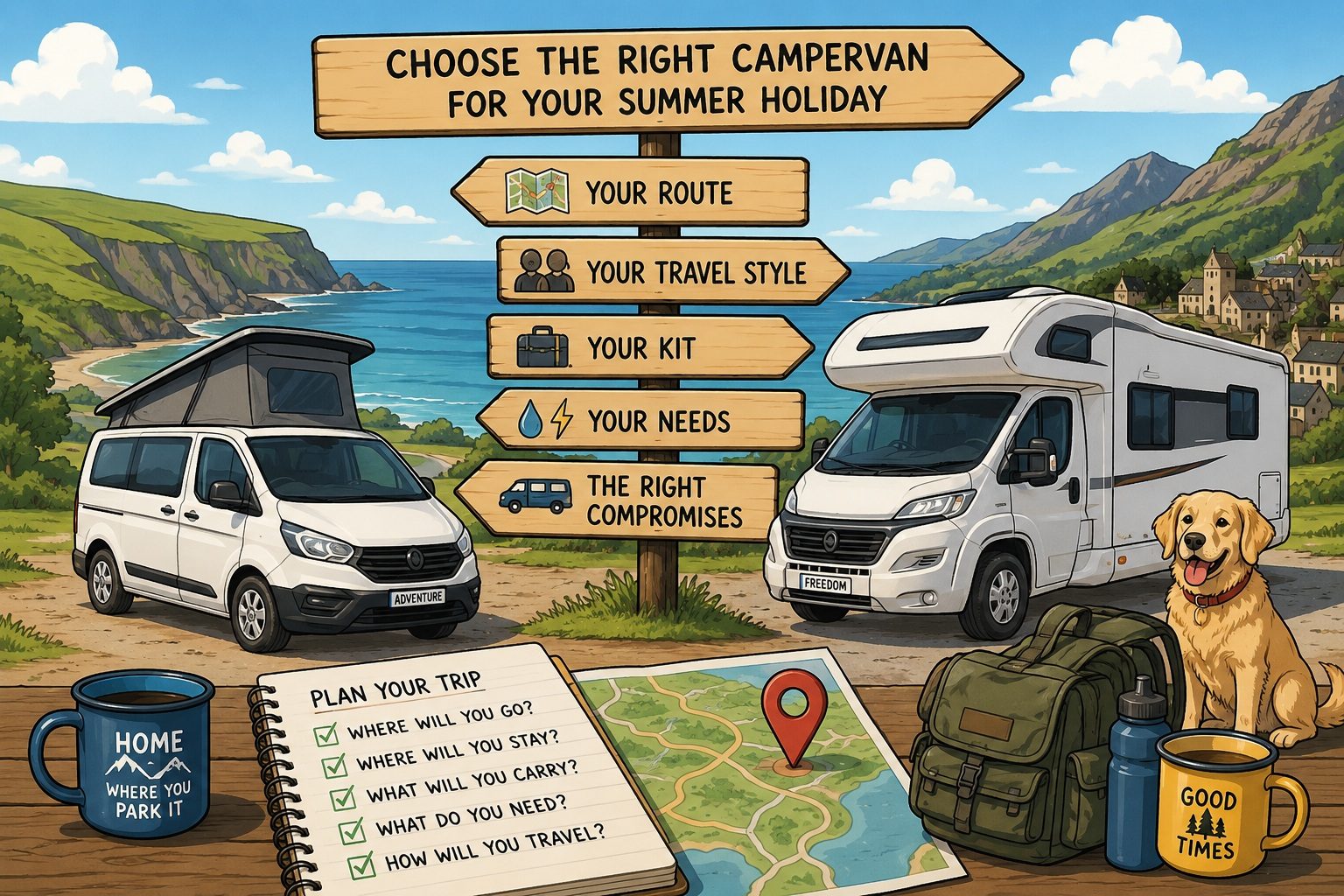
The right campervan for a summer holiday is not always the one with the longest equipment list. It is the one that suits the way you actually plan to travel.
Before comparing layouts, beds, fridges or bathrooms, start with the shape of the trip. Are you moving most days or staying in one place for longer? Are you planning campsites, informal overnight stops, festivals, beaches, mountain roads, towns, ferries or long motorway miles? Will you be carrying bikes, boards, children, wet gear or a dog?
These answers matter more than brochure language. A campervan that feels spacious on a forecourt can feel awkward on narrow lanes. A small van that is easy to park can feel cramped after three wet days. A large motorhome may give you a better bathroom and kitchen, but it can also limit where you can stop, turn around, park or get under height barriers.
Choosing well is mostly about knowing which compromises you are willing to live with.
Start with the trip, not the van
Summer campervan travel often looks relaxed from the outside, but the practical details decide how comfortable it feels once you are on the road.
A week of campsite-to-campsite travel is different from a loose coastal route with uncertain overnight stops. A two-person break with minimal kit is different from a family holiday with bedding, food, toys, outdoor chairs, walking boots and wet towels. A van for rural roads and small villages needs different thinking from one used mainly on motorways, larger roads and serviced campsites.
Before choosing a vehicle, ask yourself:
- Can you park it where you plan to visit?
- Will you be comfortable driving it on narrow roads?
- Do you need a fixed bed, or are you happy making one up each night?
- Will you use campsites with facilities, or do you need your own toilet and shower?
- How much water, power and fridge space do you realistically need?
- Where will you put wet clothes, muddy shoes, outdoor kit and rubbish?
These are not small details. They decide whether the van feels like freedom or a daily puzzle.
Small campervans: easier travel, less living space
A smaller campervan is often the easiest choice for first-time summer trips, especially if you plan to move around frequently. It is usually less intimidating to drive, easier to park and less awkward in towns, villages and tighter car parks.
That convenience comes with limits. Storage is tighter, beds may need converting, and indoor space can feel restricted when the weather turns. Cooking inside a small van can be frustrating if you are carrying lots of food or travelling with more than two people. Toilets and showers, where available, may be basic or portable rather than fully enclosed.
A compact van can work well if you are travelling light, using campsites regularly and spending most of the day outside. It can be less suitable if you want to cook proper meals every night, carry bulky sports equipment, or be self-sufficient for several days at a time.
The trade-off is clear. You gain access and simplicity, but you lose space, storage and separation.
Medium campervans: the usual middle ground
For many summer holidays, a medium-sized campervan is the most balanced option. It can give you more usable storage, a better kitchen, a more comfortable bed and enough space to sit inside when the weather changes, without becoming as restrictive as a large motorhome.
This is the size where layout matters. Two vans of similar length can feel very different. One might have a fixed bed and limited daytime seating. Another might have a flexible living area but require daily bed-making. Some layouts prioritise kitchen space. Others prioritise storage or sleeping.
Think about how you use the van during the day, not only where you sleep. If you are staying on campsites and eating out often, you may not need a large kitchen. If you are travelling with children or cooking most meals, a cramped galley can become tiring quickly.
A medium campervan is often a sensible choice for couples, small families and road-trippers who want flexibility without dealing with all the access issues of a larger vehicle.
Large campervans and motorhomes: comfort with access limits
A larger campervan or motorhome can make summer touring much more comfortable. You may get a proper bathroom, more headroom, better cooking space, larger water tanks, more storage and a fixed bed. For longer trips, families or anyone who dislikes constant rearranging, that can make a real difference.
The cost is manoeuvrability. Larger vehicles need more thought around road width, passing places, turning space, parking bays, campsite access and height restrictions. Some car parks have barriers. Some villages have tight corners. Some rural roads are manageable in a car but stressful in a wide or long vehicle.
This does not mean a larger van is a poor choice. It means the route needs to match the vehicle. You may need to plan stops more carefully, avoid certain roads, book campsites earlier and check access before arriving.
A large van suits travellers who value comfort, facilities and self-sufficiency more than spontaneity.
Do you need a toilet and shower?
This is one of the biggest decisions when choosing a campervan for summer.
A built-in toilet can be useful, especially at night, in poor weather, with children, or when campsites are busy. A proper bathroom also gives more privacy and can make longer trips easier. The downside is that it takes up space, adds cleaning duties and means dealing with waste correctly.
Showers are more complicated. A built-in shower sounds useful, but it depends on water capacity, heating, drainage and where you can refill and empty tanks. In a small van, a shower can be more of a compromise than a comfort. On a campsite, you may prefer using the site facilities. Away from campsites, you need to think carefully about water use and waste disposal.
A portable toilet or basic washing setup may be enough for short trips with regular campsite stops. For longer routes, remote areas or family travel, proper facilities may be worth the space.
Common behaviour is not the same as permission. Waste must be disposed of at appropriate facilities, and rules vary by site, region and landowner.
Power, water and fridge space matter more in summer
Warm weather changes how you use a campervan. Food storage becomes more important, water runs down faster, and phones, cameras, lights, fans and cool boxes all draw power.
A larger fridge is useful if you are cooking regularly or staying away from shops. A decent leisure battery setup matters if you are not plugging in every night. Solar can help in summer, but it should not be treated as a guarantee. Shade, weather, battery condition and how much power you use all affect the result.
Water capacity is another practical limit. Bigger tanks give more independence, but they also need filling and emptying. Smaller vans may require more frequent stops for fresh water and waste disposal.
Before booking, check what the van actually includes. Look for fridge size, battery setup, cooking equipment, water capacity, heating, ventilation and whether bedding or kitchen kit is included. Do not assume all campervans come equipped in the same way.
Parking and overnight stops need realistic planning
A campervan holiday is easier when you separate daytime parking from overnight stopping.
Daytime parking is about height barriers, bay size, road access and whether the vehicle fits without causing problems. Overnight stopping is about permission, local restrictions, signage, land ownership and behaviour. The two are not the same.
In some places, overnight parking may be allowed or tolerated. In others, it may be restricted, seasonal, locally enforced or unsuitable even if there is no obvious sign. Campsites, certificated locations, aires and official motorhome stops remove some uncertainty, but each has its own rules, facilities and booking requirements.
Summer adds pressure. Popular coastal areas, national parks and small towns can be busy. Arriving late and hoping to find a quiet spot is a weak plan, especially in a larger vehicle.
A good van choice should reflect how certain your stopping plans are. If you plan to use campsites most nights, you may need less self-sufficiency. If you want more flexible stopping, you need better water, power, toilet arrangements and a stronger understanding of local restrictions.
Match the van to your travel style
For a short summer break with lots of moving around, a compact or medium campervan is often easier to live with than a large motorhome. You will spend less time worrying about parking and more time able to change plans.
For a family holiday, space becomes more important. You need to think about sleeping arrangements, storage, mealtimes, wet-weather days and whether everyone has somewhere to sit comfortably. A van that works for two adults over a weekend may feel overloaded with children and summer kit.
For a beach or activity trip, storage and cleaning matter. Boards, bikes, walking boots, wetsuits and towels all need somewhere to go. A stylish interior is less useful if there is no practical place for damp equipment.
For a longer touring holiday, comfort and self-sufficiency carry more weight. A fixed bed, better fridge, larger water capacity and proper bathroom can reduce daily friction. The van may be less nimble, but the living experience may be better.
For a trip involving towns, ferries, narrow lanes or frequent sightseeing stops, vehicle size becomes more important again. Check length, width and height before committing.
Common mistakes when choosing a summer campervan
One common mistake is choosing the largest van available because it looks more comfortable. It may be, but only if your route, parking and confidence suit it.
Another is choosing the smallest van because it seems easier, then discovering there is not enough storage or indoor space when the weather changes.
It is also easy to underestimate how much kit summer travel creates. Outdoor chairs, food, bedding, chargers, water bottles, walking gear and wet towels all need space. Good storage is not a luxury. It keeps the van usable.
Many first-time travellers also overvalue showers and undervalue ventilation. In warm weather, airflow, shade and the ability to sleep comfortably can matter as much as bathroom facilities.
The final mistake is assuming informal overnight stops will always be available. They may not be. Rules vary, local pressure changes, and some areas become much stricter in summer. Check current local restrictions before relying on any stop.
What to check before booking or buying
Before committing to a campervan, check the practical details rather than relying on category names.
Check the vehicle length, width and height. Check the sleeping layout and whether beds are fixed or converted. Check the number of belted seats, not only the number of berths. Check storage for bulky kit. Check whether there is a toilet, shower, hot water and heating. Check fridge size, water capacity and power setup.
If hiring, check mileage limits, insurance excess, breakdown cover, deposit terms, pick-up times, cleaning rules, pet rules and what equipment is included. Summer demand can make availability tighter, so the practical terms matter.
If buying, take more time. Think about where the van will be parked at home, whether it fits your licence and confidence, how it will be serviced, and whether the layout suits real use rather than a weekend viewing.
The best campervan is the one with the right compromises
There is no single perfect campervan for summer holidays. A small van gives easier access but less space. A larger van gives comfort but needs more planning. A full bathroom adds independence but takes room. A basic setup keeps things simple but may rely more heavily on campsites.
The right choice is the one that fits your route, your stopping plans, your passengers and your tolerance for daily compromises.
Start with the trip you are actually taking. Then choose the van that makes that trip easier, not the one that looks most appealing in isolation.