
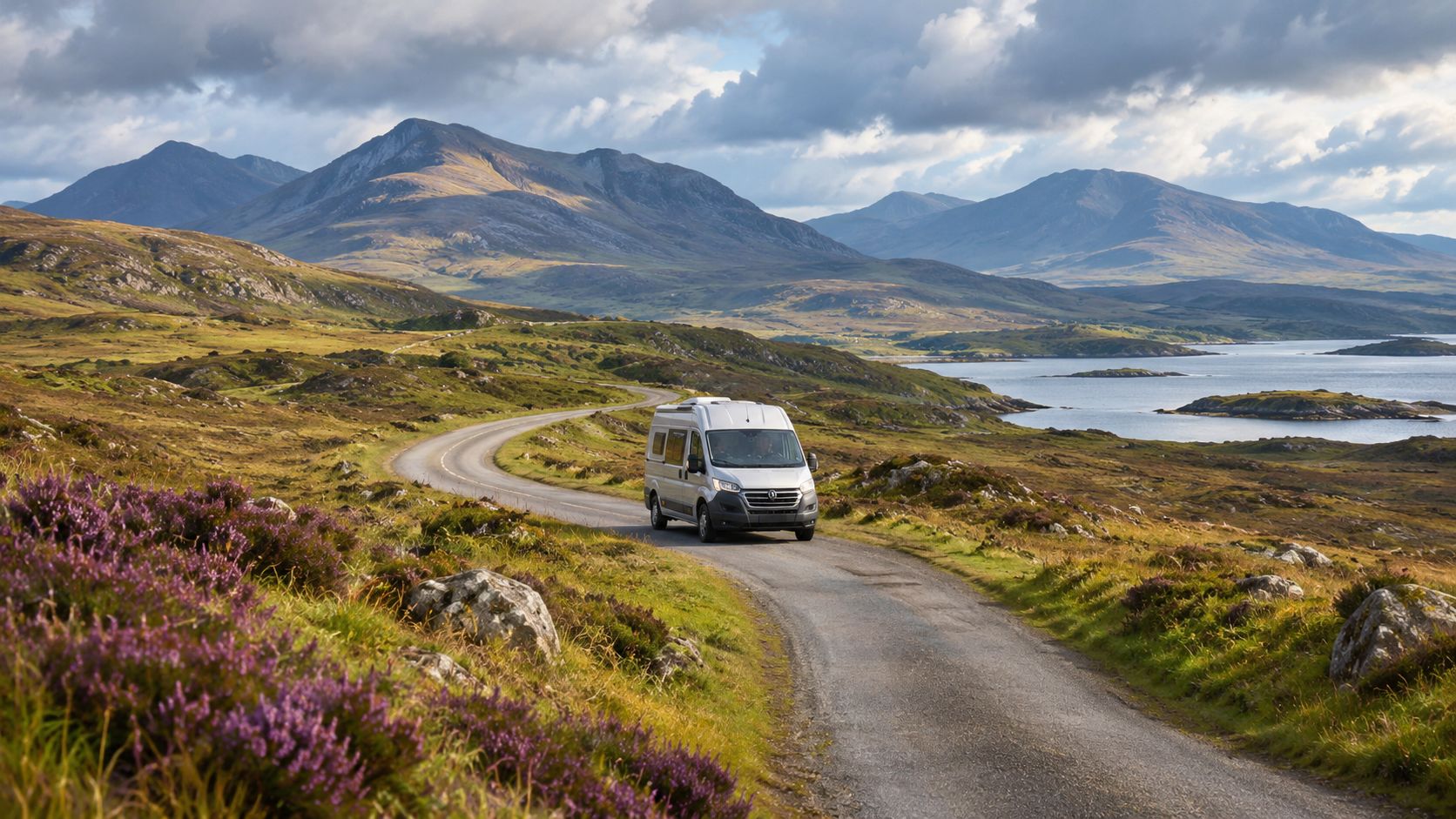
Travelling the North Coast 500 in a campervan is a rewarding way to explore the Scottish Highlands, provided you’re comfortable driving on narrow roads, prepared for changeable weather and realistic about how much ground you can cover each day.
The North Coast 500, or NC500, is a 516-mile circular route starting and finishing in Inverness. You can travel in either direction, discovering mountains, lochs, beaches and small coastal communities along the way.
What is it like driving the NC500 in a campervan?
Driving the NC500 requires a little more patience than your average road trip. Sections of single-track road mean regularly encountering oncoming traffic, using passing places and occasionally having to reverse. If you’re unfamiliar with driving a larger vehicle, this can initially feel quite daunting.
Before setting off, make sure you’re comfortable reversing your campervan accurately and safely. It’s a skill you’ll need on single-track roads, rather than something you want to learn when another vehicle is waiting for you to move.
We found the driving became less intimidating with practice. Taking things slowly, staying alert and accepting that there would be occasions when we needed to wait made the journey much more enjoyable.
Mobile phone coverage can also be patchy in remote parts of the Highlands. Downloading your route for offline use or carrying a physical map means you won’t be entirely dependent on having a signal to find your way.
Weather Woes and Wins
Scottish weather has a habit of changing the character of a journey remarkably quickly. Clear views can disappear into low cloud, rain can arrive unexpectedly and a cold wind can make even a summer afternoon feel decidedly less summery.
Keeping warm and waterproof clothing somewhere easily accessible in the van is worthwhile. The weather changed the feel of our journey more than once, but being prepared meant it didn’t have to dictate our plans.
There’s an enjoyable side to the changing conditions, too. The same landscape can look completely different after a passing shower or when sunlight breaks through the clouds. We came to appreciate that variety rather than seeing every change in the weather as an inconvenience.
When is the best time to travel the NC500?
April to June and September to October are good periods to consider if you’re looking for relatively mild weather while avoiding the busiest part of the summer. Whatever time of year you choose, keep an eye on the Highlands weather forecast and remain flexible with your plans.
Midges are another consideration, particularly between May and September. They’re most noticeable during still, damp conditions, especially in the western Highlands, and can be particularly troublesome in the early mornings and evenings.
If you’re planning walks, evenings outside the campervan or simply spending time enjoying the surroundings, insect repellent is worth adding to your packing list.
The Call of the Wild(erness)
Part of the appeal of travelling the NC500 in a campervan is having the flexibility to stop and enjoy your surroundings. However, it’s important to understand the difference between wild camping and staying overnight in a vehicle.
Can you wild camp in a campervan on the NC500?
Scotland’s outdoor access rights allow responsible lightweight camping, but they do not extend to motor vehicles. Travelling in a campervan or motorhome does not give you an automatic right to park or sleep overnight wherever you choose.
Overnight stays depend on whether parking is lawful, whether any necessary permission has been granted and whether local restrictions permit you to stay. An appealing location is not necessarily somewhere you’re allowed to spend the night.
Wherever you choose to stay, leaving the surroundings as you found them is important. Much of the enjoyment of travelling through this part of Scotland comes from its natural environment, and looking after it is everyone’s responsibility.
Fuel, Food and Essential Facilities
Petrol stations, shops and sanitation facilities can be less frequent along the remote sections of the NC500 than you might be accustomed to elsewhere in the UK.
We noticed that finding food and everyday supplies sometimes needed more thought than expected. It wasn’t a major problem, but we soon appreciated the value of stocking up when the opportunity arose rather than assuming there would be another shop around the next bend.
There’s a positive side to this, too. Buying supplies from local shops and using local services helps support the small communities that make the NC500 more than just a scenic driving route.
Campervan waste disposal
If your campervan has an onboard toilet or waste water tank, think about where you’ll empty them during your journey. Some campsites provide chemical toilet and grey water disposal facilities to passing travellers for a fee, even if they’re not staying overnight.
Always use designated disposal facilities. Ordinary public toilets are not suitable for emptying chemical toilets, and waste water should not be discharged into the surrounding countryside.
Booking campsites and checking seasonal opening times
If you’re planning to use campsites or other accommodation during the busier months, booking ahead can save you unnecessary stress. Leaving every overnight stop until the last minute may limit your options.
Travelling outside the main holiday season requires some planning as well. Some accommodation providers and visitor attractions close for parts of the year, so check opening arrangements for anywhere you’re particularly keen to visit.
How long should you allow for the North Coast 500?
The official NC500 guidance recommends allowing at least five to seven days to experience the route properly. Although the mileage might tempt you to complete it more quickly, the distance doesn’t really account for how often you’ll want to stop.
Mountains give way to lochs, open moorland leads towards the coast, and waterfalls, beaches and small settlements provide plenty of variety along the journey.
We found that the scenery changed often enough for the journey rarely to feel repetitive. It creates what you might call a problem of plenty: there’s always another reason to stop or another stretch of the Highlands that deserves a little more of your time.
Allowing several days meant we could take breaks and stop when something caught our attention without feeling that every pause was putting us behind schedule. That’s particularly appealing if you’re interested in photography, walking or simply exploring the places you encounter along the way.
Is Vanlife on the North Coast 500 Worth It?
For us, absolutely. The practical challenges didn’t spoil the journey. They encouraged us to slow down, pay more attention to our surroundings and appreciate the differences between each part of the route.
You don’t need to be a committed vanlifer to enjoy the NC500, either. It’s equally appealing as a road trip for couples, families and car travellers, with plenty of reasons for walkers and dog walkers to spend time away from their vehicles.
Perhaps the most valuable thing you can give yourself on the NC500 isn’t another destination to tick off your list, but enough time to enjoy the ones you discover along the way.
Your turn: If you’ve travelled the North Coast 500 in a campervan, what do you wish you’d known before setting off?
Please check out the SOAC, it does not include vehicles infacr specifically excludes activities reliant on motorised activities.
Please correct as this isinformation is leading to environmental damage & conflict with residents.
For further information check out Highland Council’s advice on Visiting in otorhomes/Campervans.
https://www.highland.gov.uk/downloads/download/1999/visiting_the_highlands
Thanks for your comment. We did check the code and it only says “ If public or private land owners restrict or regulate parking on their land, you must comply with this.”
Thank you for your reply.
It doesn’t only say that, it also says:
“Access rights do not include motor vehicles.”
Please check out:
https://www.legislation.gov.uk/ukpga/Vict/28-29/56
and
https://www.legislation.gov.uk/ukpga/1988/52/section/34
Please also download the link above to Highland Council advice.
Either way, you cannot “wild camp” in a vehicle in Scotland is you are travelling in a vehicle. The laws are the same in Scotland as they are in the rest of the UK.
“The laws are the same in Scotland as they are in the rest of the UK.“
That’s exactly the point. There are no laws in the U.K. that say you can’t sleep in your vehicle as long as you’ve parked it legally. Obviously you can’t go driving over moorland in your van but we’d hope a bit of common sense would have made that obvious.
From The Land Reform Act 2003.
Section 9.
Conduct excluded from access rights
The conduct which is within this section is—
(a)being on or crossing land in breach of an interdict or other order of a court;
(b)being on or crossing land for the purpose of doing anything which is an offence or a breach of an interdict or other order of a court;
(c)hunting, shooting or fishing;
(d)being on or crossing land while responsible for a dog or other animal which is not under proper control;
(e)being on or crossing land for the purpose of taking away, for commercial purposes or for profit, anything in or on the land;
(f)being on or crossing land in or with a motorised vehicle or vessel (other than a vehicle or vessel which has been constructed or adapted for use by a person who has a disability and which is being used by such a person);
(g)being, for any of the purposes set out in section 1(3) above, on land which is a golf course.
This is the law in Scotland, the SOAC is guidance only.
Wild camping, a favourite aspect of vanlife, is permitted under the Scottish Outdoor Access Code,
Wild camping is permitted by the SOAC but NOT in a van, motorised vehicles are specifically excluded.
Yes you can sleep in your vehicle, to rest, you cannot camp. If you are going to sleep in your vehicle you must be self self contained as in no bbq, chairs out with the vehicle. So you’re wrong to to suggest ‘wild camping’ with any type of motorised vehicle.
Your blog is being invaded by a bunch of miserable no-life misanthropes from a Facebook group called NC500 The Land Weeps. Feel free to join and engage with the community there.
No they’re just people who are fed up of seeing vans in every view point, beach car park, cemetary car parks, passing places. Toilet cassettes emptied in lay-bys. . In England signs have gone up everywhere about no overnight parking it’s on a lot of videos, they even say head to Scotland. Height restrictions are in place too and they say now head to Scotland it’s easier to wildcamp where you like so Scotland will change to be like England because people like you won’t pay. I do but I don’t blame them one bit for moaning. It seems a constant battle against rude and ill mannered people who think they’re entitled to park where they like. You’re spoiling it for all of us. There’s very reasonably priced Aires in gorgeous spots but they aren’t used
It seems to be this article is promoting respectful and legal activities