
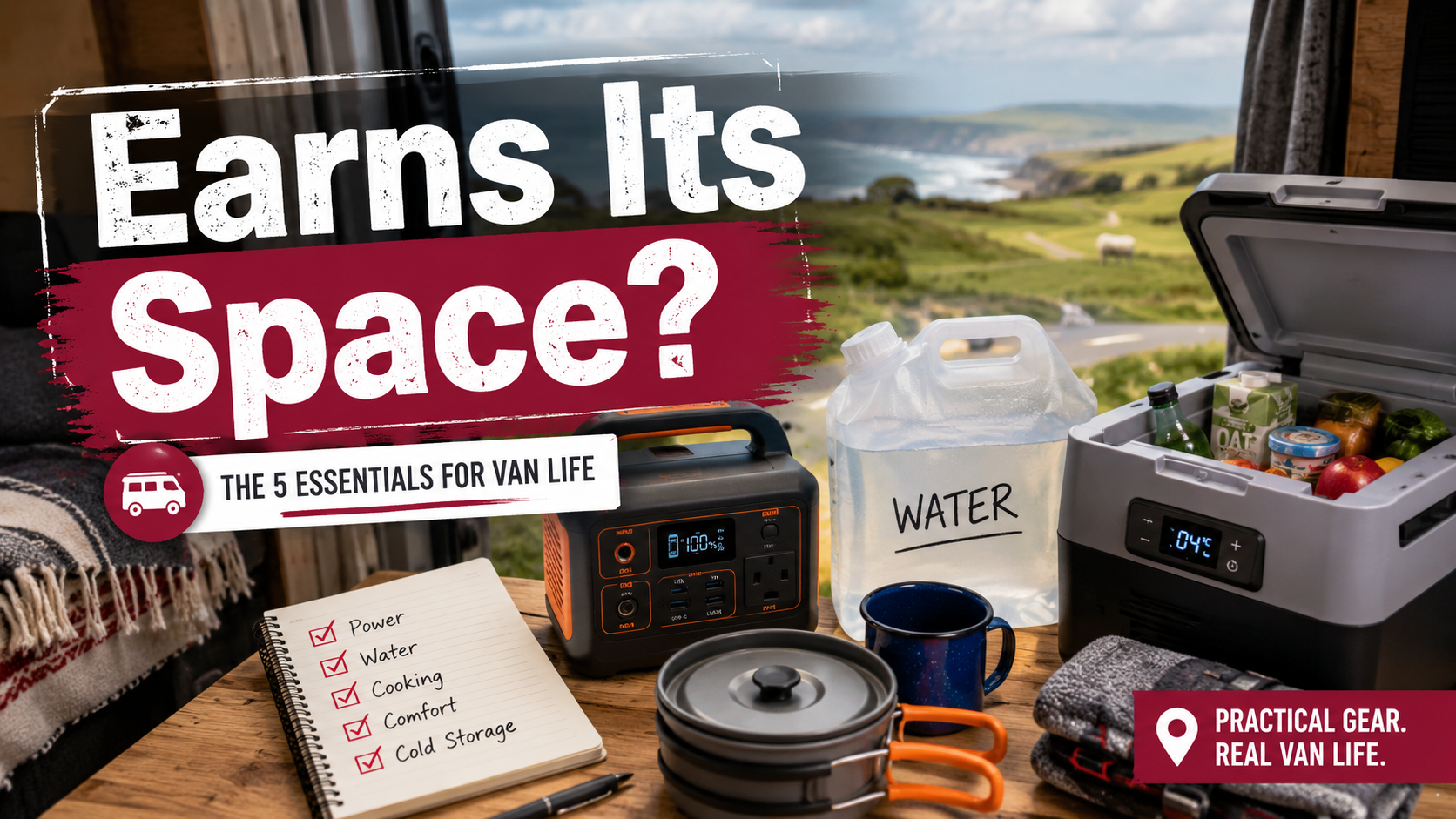
Van life gives you the freedom to travel at your own pace and make more of the space you have, but a few well-chosen essentials can make life on the road considerably easier. You do not need to fill the van with gadgets. The useful kit is the stuff that solves everyday problems, whether that is keeping the lights on, making better use of limited space or dealing with the practicalities when there are no facilities nearby.
These are five van life essentials that can make travelling more comfortable, practical and self-sufficient.
1. Solar Power System
A reliable solar power system can be the backbone of modern van life, particularly if you spend time away from campsites. It gives you a way to keep batteries topped up and run suitable 12V equipment without relying entirely on electrical hook-ups or starting the engine just to charge your leisure battery.
- Energy independence: Solar can reduce your reliance on campsite hook-ups and give you more flexibility when travelling away from serviced pitches.
- Renewable power: Solar panels give you a renewable way of generating electricity while you travel.
- Potential savings: Using solar may reduce how often you need a pitch purely for electrical hook-up, although whether the system eventually pays for itself depends on its cost, your power use and the way you travel.
Before choosing a system, think about the size of your battery bank and how much electricity you actually use in a day. Roof-mounted panels are convenient, while a portable panel can give you extra flexibility when the van is parked in shade or you want to make better use of the available sun.
Just bear in mind that solar output drops in poor weather. Combining fixed and portable panels can help, but it does not guarantee enough power on cloudy days. Your system size, battery capacity, shading and daily consumption all matter.
2. Portable Toilet
Living on the road means you will not always have access to public toilets. A portable toilet can be a game-changer for van travellers, especially on longer journeys, late-night stops or trips where facilities are limited.
- Convenience: You are not completely dependent on finding a public facility whenever you need one.
- Privacy and hygiene: Having your own toilet gives you a private option inside your setup and means you know exactly how it has been maintained.
- Environmental consideration: A portable toilet is a much better option than wild toileting when used and emptied responsibly.
Choose a toilet that suits both the available space and the way you travel. Options range from simple compact models to larger systems with waste tanks and flushing mechanisms.
Waste should be emptied responsibly at an appropriate disposal point, following the requirements of the campsite, stopover or local area. It should never be dumped where disposal is prohibited or into natural water sources.
3. Insulation and Ventilation
Comfort in a van depends heavily on insulation and ventilation. They work together, helping to manage temperature while reducing the moisture that builds up through everyday things such as cooking, sleeping and simply spending time inside.
- Temperature control: Good insulation helps the van retain warmth in colder weather and reduces heat transfer when temperatures rise. Foam boards, reflective insulation and wool are among the common options used in van conversions.
- Condensation prevention: Ventilation helps moisture escape instead of collecting on windows and other cold surfaces, where persistent damp can contribute to mould and mildew.
- Energy efficiency: Better insulation can reduce the demand placed on heating or cooling equipment, which is useful when your available energy is limited.
Window coverings can also help with temperature control and privacy. A roof vent, particularly one with a fan, gives you a more effective way to move air through the van when passive ventilation is not enough.
4. Multi-Functional Furniture
Space is at a premium in a van, so furniture that earns its keep in more than one way makes a real difference. The aim is not to cram in as much as possible, but to make the available space work harder.
- Convertible bed: A bed that converts into seating or a dining area can save a considerable amount of space. Storage underneath makes it even more useful.
- Foldable table: A folding or collapsible table can cover dining, working and food preparation, then disappear when you need the floor space back.
- Storage solutions: Overhead cupboards, drawers and under-bed compartments help keep everyday kit organised and stop the living space becoming cluttered.
Modular and lightweight designs are particularly useful because they give you more flexibility as your setup changes. Weight matters too. Furniture, batteries, solar equipment, water, fridges and everything else you add all count towards the vehicle’s maximum authorised mass, so it is worth keeping an eye on the total rather than considering each item in isolation.
5. Portable Cooking Equipment
Being able to prepare your own food is one of the most useful parts of travelling in a van. It can save money, gives you more control over what you eat and means you are not dependent on finding somewhere open every time you want a hot meal.
- Camping stove: A portable camping stove can be useful when you have a safe and suitable place to cook outdoors. Choose a model that uses a fuel you can readily obtain while travelling. Portable fuel-burning camping stoves should not be used inside the van. If you cook inside, use a properly installed appliance designed for that purpose.
- Cookware: Lightweight, durable pots, pans and utensils make sense when storage is limited. Equipment that stacks neatly is particularly handy in a small kitchen area.
- Portable fridge or cooler: For longer trips, a suitable 12V fridge can make keeping fresh food much easier, provided your electrical setup can support it. A passive cooler does not need electrical power but relies on insulation and ice packs, so the better choice depends on your setup, journey length and available power rather than one simply being more efficient than the other.
If your van has fuel-burning appliances, a working carbon monoxide alarm is an important safety measure. For use in caravans and motorhomes, look for an alarm tested to BS EN 50291-2 and follow the manufacturer’s instructions for positioning and testing it.
Meal planning helps too. Keeping a few non-perishable basics in the van means you can put something together even when shops are closed or plans change.
You do not need every possible van accessory to travel comfortably. A sensible electrical setup, somewhere to deal with toilet needs, proper insulation and ventilation, furniture that uses the available space well and a safe way to prepare food cover a lot of the everyday practicalities.
Get those basics right and you have a setup that is easier to live with, whether you are heading away for a weekend or spending much longer on the road. From there, you can add the things that suit the way you actually travel and be better prepared for whatever the road throws your way.