
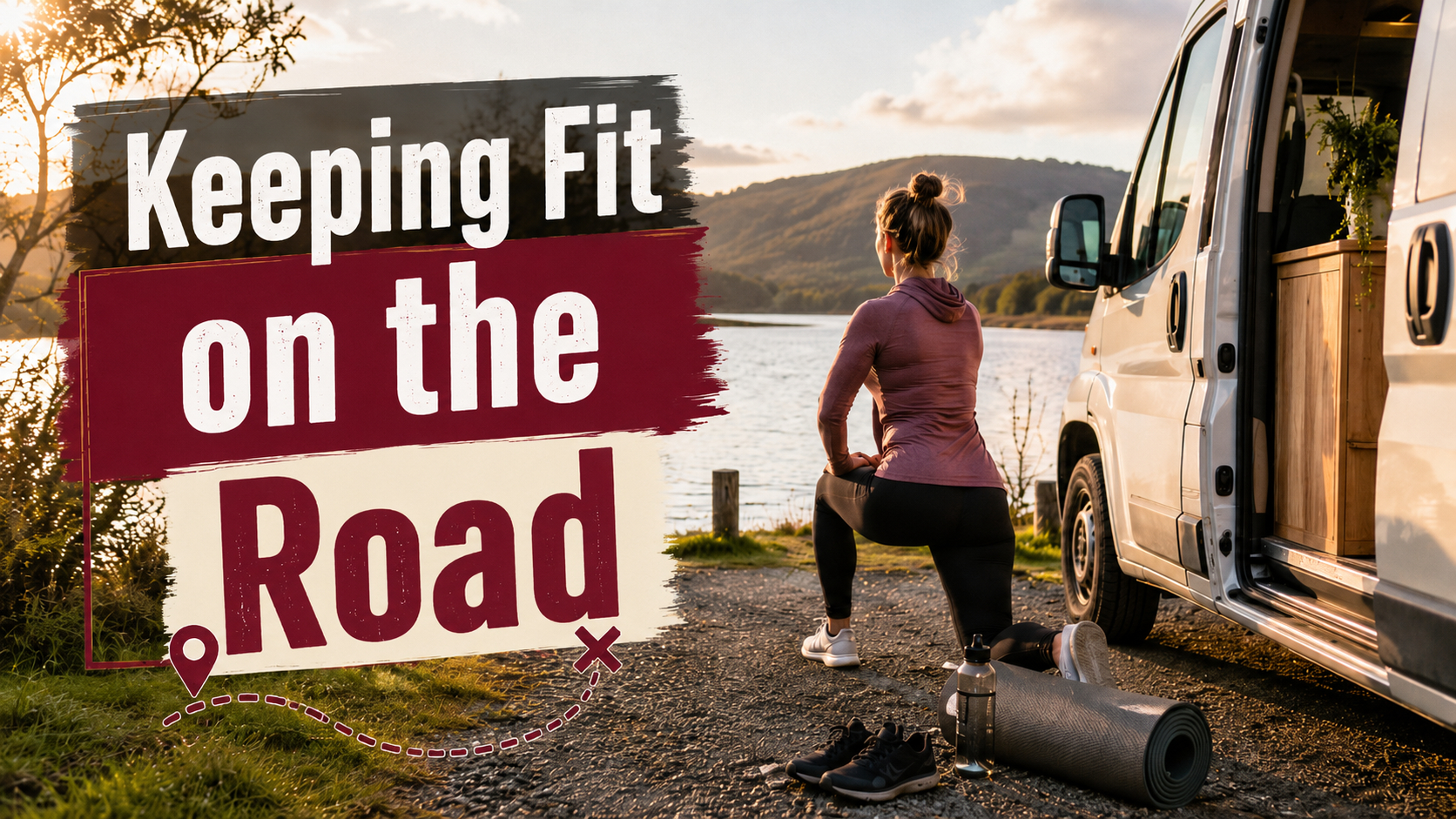
Keeping fit on the road can be a bit of a contradiction. Travelling by van gets you outdoors and takes you to places made for walking, running and exploring, but it can also mean long hours behind the wheel, irregular days and no obvious place to exercise.
The good news is that you do not need a gym or a complicated routine. One of the best things about travelling is that your surroundings keep changing, effectively giving you an ever-changing, open-air gym. A walk in the hills, a run through the woods or twenty minutes of bodyweight exercises beside the van can all count.
The key is to work with the journey rather than trying to force a normal gym routine into it. Some days you might have time for a proper workout. On others, getting out for a decent walk after several hours of driving may be enough.
If you have not exercised for a while, or you have a health condition or any concerns about starting something new, choose activities that suit your current fitness level and get professional advice where needed. If an exercise causes pain or makes you feel unwell, stop.
1. Harnessing the Power of Nature
When you are travelling, the easiest workout is often the one already outside the door. Instead of looking for somewhere specifically to exercise, make use of the landscape you have stopped to explore.
If you have been sitting behind the wheel for a while, give yourself a few minutes to loosen up and warm up before heading straight into a harder run, hill session or circuit.
Mountain Workouts: Hills are an obvious place to start. A brisk walk on steeper ground gives your legs something to do while raising your heart rate, and trail running can turn an ordinary run into a much more varied session. You are getting your exercise while seeing the place you travelled to, which feels rather more worthwhile than staring at a gym wall.
If climbing is already one of your activities, being in the hills may give you opportunities to combine it with a day outdoors. It is not something to improvise, though. Anyone new to outdoor climbing should learn the necessary skills through an experienced climber, organised course or qualified instructor.
Beach Workouts: Beaches give you plenty of room to move when conditions allow. A game of frisbee or beach volleyball gets you active without feeling much like exercise, while lunges, push-ups, burpees and other bodyweight movements can easily be turned into a short circuit. Working on sand can also make familiar movements feel noticeably different.
Forest Workouts: Woodland is just as useful if you fancy something more active than a gentle wander. Trail running over uneven ground changes the demands on your legs and stabilising muscles as you deal with slopes, roots and changes in the surface. Even if running is not your thing, a purposeful walk through hilly woodland can still make a decent workout.
2. Exercise Using Your Van
Your van can be more than just a mode of transport and a place to sleep, although that does not mean every bumper, ladder and roof rack should suddenly become gym equipment.
Strength Training: You can do a surprising amount with bodyweight alone. Squats, lunges, push-ups and similar exercises need very little equipment and, when you have a suitable bit of space, can be done beside the van.
Be more cautious about using the vehicle itself for support. Van fittings vary enormously and something that looks sturdy is not necessarily designed to take a person’s weight. Only use a step, rail or other fitting if you know it is suitable for the load involved.
Flexibility Training: Stretching, Pilates and yoga are useful options when you want something gentler. If your van layout leaves enough clear floor space for a mat, you may be able to exercise indoors. Plenty of smaller conversions will not, so there is no shame in taking the mat outside when the weather and surroundings make that practical.
3. Portable Fitness Equipment
Storage space matters in a van, so fitness equipment has to earn its place. Fortunately, you do not need to carry a collection of weights around the country to add some variety to your workouts.
Resistance Bands: Resistance bands take up very little room and can be used for a wide range of strength exercises. Different resistance levels also let you make exercises easier or harder without filling a cupboard with equipment.
Jump Rope: A skipping rope is about as compact as cardio equipment gets. With enough clear outdoor space, it can provide a quick workout on its own or form part of a higher-intensity interval session.
Yoga Mat: A mat is useful for far more than yoga. Stretching, Pilates, mobility work and floor exercises are all more comfortable with one, particularly when the alternative is gravel, cold ground or a van floor.
Suspension Trainers: Systems such as TRX can also pack down fairly small while offering plenty of bodyweight exercises. The important bit is the anchor. It needs to be capable of supporting your full body weight, so do not assume that a van ladder, roof rack, tree or other convenient-looking object is suitable without knowing it can safely take the load.
4. Tech-Assisted Workouts
If you prefer somebody else to provide the structure, your phone or tablet can do a decent job of filling in for a gym class. This can be particularly handy when travelling because you can choose a session to fit the time, space and equipment you actually have that day.
Fitness Apps: Nike Training Club offers guided workouts, while MyFitnessPal can be useful if you like tracking your activity alongside food and fitness goals. There are also plenty of short bodyweight and seven-minute-style workout apps for those days when twenty minutes sounds ambitious.
If an app lets you save workouts for offline use, download a few before travelling. A beautifully organised exercise plan is not much use if it disappears the moment your phone signal does.
Online Fitness Classes: Services such as Peloton and FIIT offer live and on-demand sessions covering areas including cardio, strength, yoga and meditation. They can bring a bit more routine to life on the road, although streaming classes will obviously depend on having a reasonable internet connection.
5. Prioritising Routine and Consistency
Routine is probably the hardest part of exercising while travelling. Van trips are rarely built around doing the same thing at the same time every day, and trying to make them fit a rigid fitness schedule rather defeats the point.
A more realistic approach is to decide where exercise can slot naturally into the day. You might prefer doing something in the morning before setting off, walking once you arrive somewhere or fitting in a short session before settling down for the evening.
Short workouts still count and can be much easier to maintain during busy travel days. At the same time, do not dismiss the longer walk, cycle or run you manage on another day simply because your week has not followed a tidy schedule.
As a useful benchmark, UK guidance recommends that adults aim for at least 150 minutes of moderate-intensity activity or 75 minutes of vigorous activity each week, along with muscle-strengthening activity on at least two days. That total can be built up through sessions of different lengths, which fits travelling rather better than an all-or-nothing approach.
6. Incidental Exercise
Not all exercise needs leggings, a stopwatch or the intention of doing a workout. Travelling gives you plenty of opportunities to move more simply by changing how you get around once the engine is off.
Cycle to a nearby shop instead of driving if it is practical. Explore a town on foot. Take the longer wander to a viewpoint rather than treating every outing as a mission to get there and back as quickly as possible.
You can also use the simple Park and Walk approach, leaving the vehicle further from your destination when it makes sense and covering the final stretch on foot. None of this feels particularly dramatic, but that is rather the point. Movement built naturally into the day is much easier to keep doing.
7. Fuelling Your Fitness
Food on the road can become whatever is quickest when you are tired, hungry and still need to work out where you are sleeping. A little planning makes it easier to keep meals reasonably balanced without turning van cooking into a nutrition project.
A mixture of protein, carbohydrates, fruit and vegetables gives you a sensible base for an active trip. The aim is not to eat perfectly. It is simply to have enough decent food available that the easiest option is not always whatever happens to be closest.
Remember fluids as well. You are likely to need more when exercising and during hotter weather, so keeping water accessible is one of those simple habits that is easier than realising halfway through a walk that you left it in the van.
8. Importance of Rest and Recovery
There is no prize for turning every travel day into a workout. Rest matters too, particularly when exercise is sitting alongside long drives, walking days and the general disruption that comes with regularly moving from one place to another.
A good night’s sleep gives your body time to recover and helps with energy levels the following day. Gentle stretching, yoga or an easy walk can also be useful when you feel stiff after driving or want some movement without another hard session.
Ultimately, keeping fit on the road is less about following a perfect exercise programme and more about noticing the opportunities that travelling already gives you. Walk the hill. Take the longer route. Stretch after the drive. Do a quick workout when you have the space and leave it alone when your body needs a rest.
The scenery will change, the days will change and your routine probably will too. If you can adapt with them, staying active becomes part of the journey rather than another job you are trying to squeeze into it.