
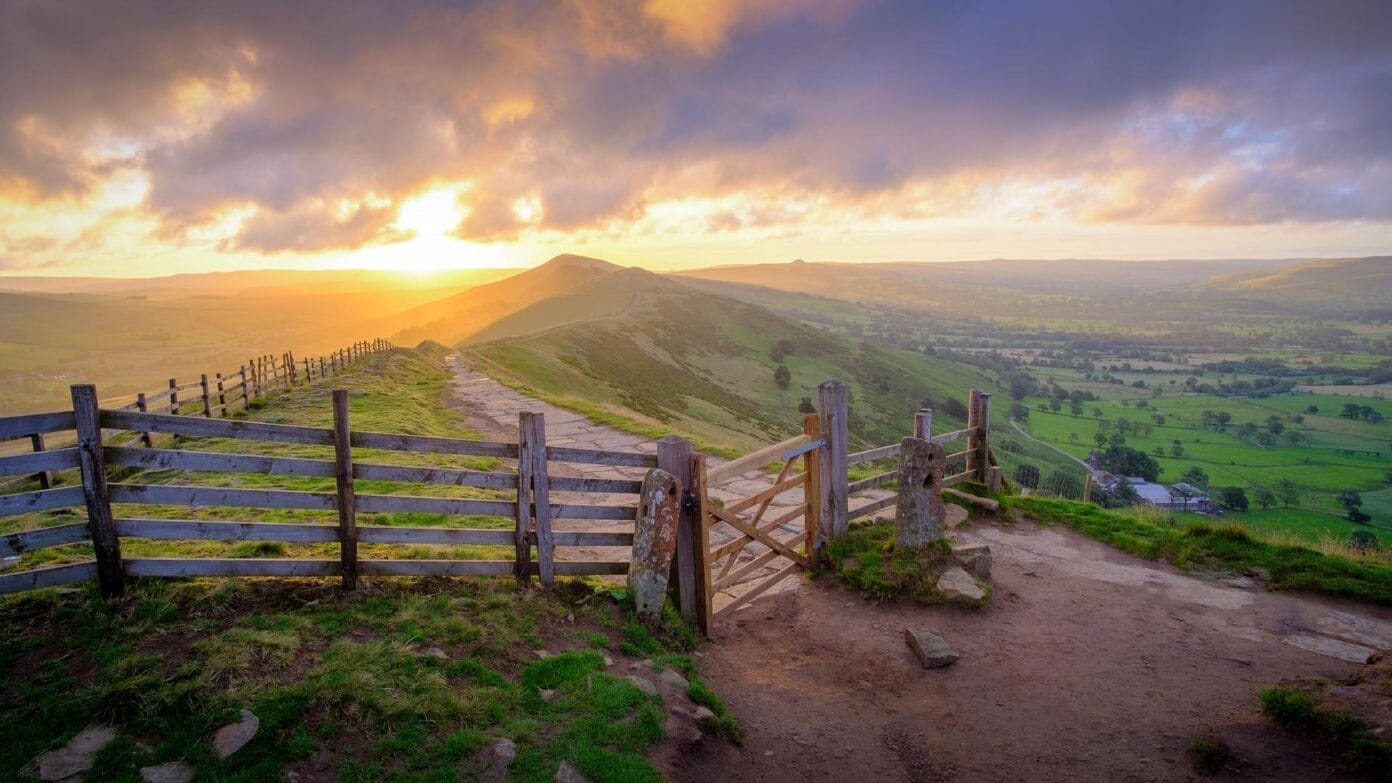
The Peak District is one of those parts of England where you can slow down and let the countryside set the pace. It is not showy, but it has places that stay with you: high gritstone edges, wooded paths, old villages and large estate grounds where there is room to wander.
These four places stood out for us on our visit. They are all different, so they work well as separate stops on a longer Peak District trip, whether you are walking, road-tripping, travelling by car, or planning your route in a van or campervan.
1. Stanage Edge
Our first stop was Stanage Edge, a long gritstone ridge just north of Hathersage. It runs for about 3.5 miles, with a track along the top that you can follow on foot. The walk gives you that open Peak District feeling quite quickly, with moorland and fields spreading out in different directions on a clear day.
If you are into climbing, there are plenty of routes on the rock face. If you are not, it is still a satisfying place to walk, pause and take in the view before heading back down. It is the sort of stop that suits walkers, couples, families with older children, and anyone who wants a proper stretch of open countryside without overcomplicating the day.
Afterwards, we went down into Hathersage village for a meal in one of the pubs and a look around the churchyard. There is a grave there traditionally said to be that of Little John, connected to the Robin Hood stories. It makes Hathersage a useful follow-on stop rather than just somewhere to pass through.
From a road-trip or campervan point of view, Stanage Edge is worth planning as part of the wider day rather than treating it as a quick roadside pull-in. The landscape feels open, but the surrounding villages and lanes are still places where it helps to think about your approach, your stopping point and what you want to do afterwards.
2. Lud’s Church
Further on, in a wooded section near the Roaches, we found Lud’s Church. It is a narrow, mossy chasm with a very different feel from the open edges elsewhere in the Peak District. Light filters down through the trees, and the rock walls are steep, green and quiet.
There is a sense of age here. Local tales connect the spot with 14th-century religious dissenters, and it is easy to understand why somewhere so enclosed and sheltered might have been used as a meeting place long ago.
We stood in the shade for a while, noticing the damp air and the quiet. It is not a place that needs to be rushed. The appeal is in the atmosphere as much as the walk itself, so it suits travellers who like slower stops, woodland paths and places with a bit of story behind them.
For anyone travelling by van or campervan, the main practical point is to treat Lud’s Church as a walking stop rather than a drive-up viewpoint. The experience comes from getting into the woodland and following the route in on foot, so it is worth allowing enough time rather than squeezing it in between longer drives.
3. Castleton
Castleton is a village you come to for more than just scenery. Its stone cottages and pubs are what many people picture when they think of a Derbyshire village, and after a day on the hills it is a good place to sit down, have a drink and look over a map.
Not far from the centre are several show caves. We went into Peak Cavern, which locals sometimes call the Devil’s Arse, and joined a guided walk through the stalactites and passages while learning about the area’s mining past.
Castleton works well as a base-style stop within a day out because it gives you a change of pace. You can move from hills and caves to food, pubs and village streets without feeling as though you have left the character of the Peak District behind.
It is also the kind of place where road-trippers and campervan travellers need to be a little more deliberate. Popular villages can feel tight and busy compared with the open hills, so it is better to plan your visit with enough time to arrive, park appropriately and explore on foot rather than rushing through.
4. Chatsworth House
On the southern edge of the park lies Chatsworth House, the seat of the Devonshire family for generations. It is a large old house with rooms full of paintings, furniture and other items you would not see every day.
The gardens around it are extensive too, with lawns, paths and water features that take a while to explore. When we were there, other visitors were scattered about, but there was still room to breathe and wander at our own pace.
Occasionally the estate runs events such as country fairs or horse trials, which bring more people in. On a normal day, though, it feels quite calm, especially if you are happy to take your time rather than trying to see everything at once.
Chatsworth adds a different side to a Peak District trip. After edges, woods and villages, it gives you estate grounds, gardens and house interiors. For families, couples and general visitors, it is an easy way to balance outdoor stops with something more structured.
Planning these Peak District stops
These four places show different sides of the Peak District: high gritstone edges, quiet wooded paths, village life and country estate grounds. None of them needs to be rushed, and they work best when you give each place enough space in the day.
If you are travelling by car, van or campervan, it helps to think of them as proper stops rather than quick ticks on a map. Some are better suited to walking, some to lingering over food or a drink, and some to slower exploring once you have arrived.
Taken together, they make a good introduction to the Peak District. You can walk, climb, visit a village, explore a cave, wander through gardens, or just sit with a flask and a view. That mix is what makes the area so easy to come back to.