
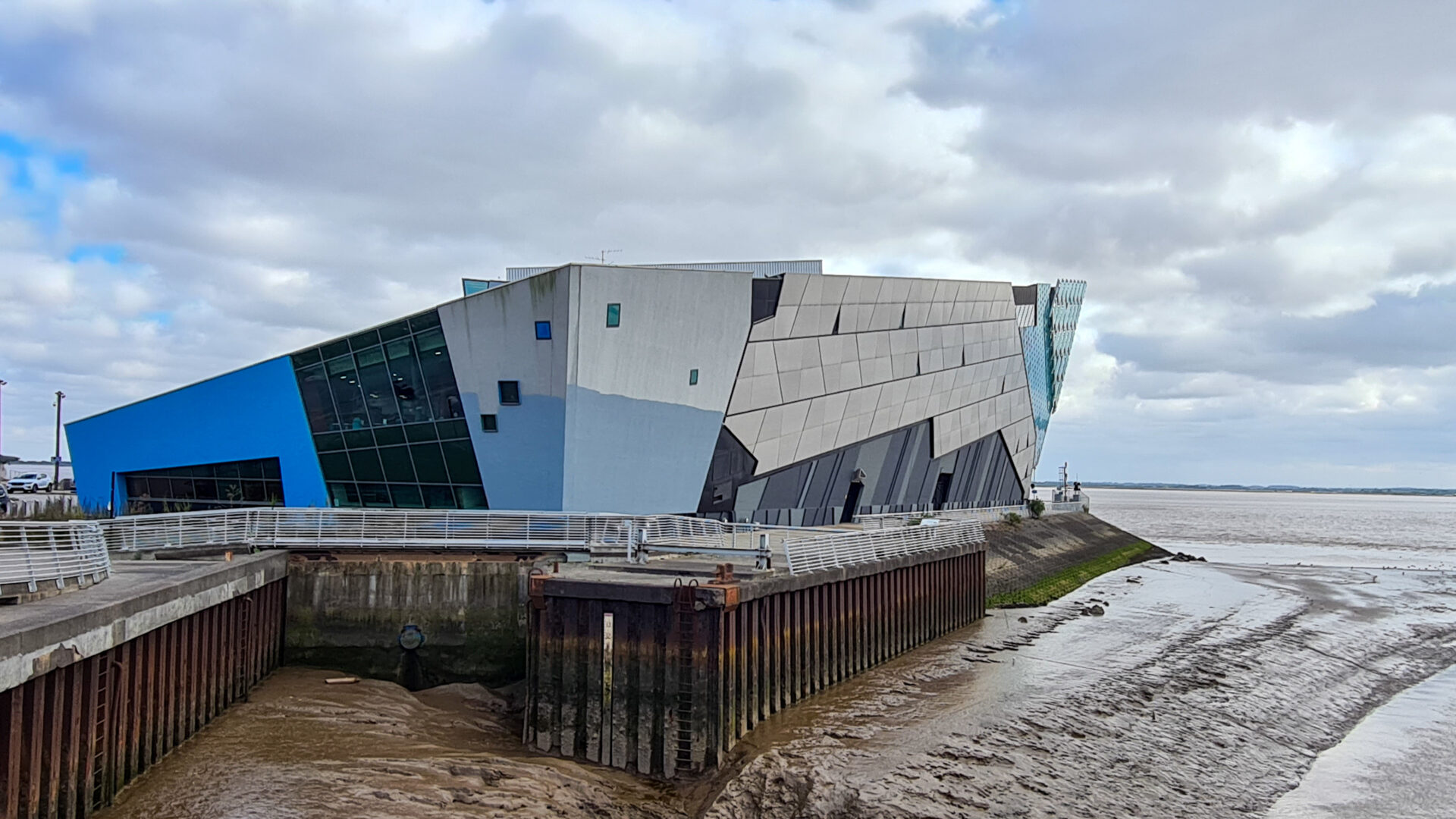
The Deep in Hull is one of those places we had talked about visiting for years. Like so many good intentions, it kept getting pushed back. This time, while passing through Hull on a trip, we finally made the effort to stop. I am glad we did.
I will be honest, I was expecting a fairly standard aquarium with tanks of fish and perhaps a shark or two. What we found was much more interesting than that. The Deep feels part aquarium, part museum and part education centre, with enough to keep adults as engaged as children.
From the moment we walked into the sharp glass building at the meeting point of the River Hull and the Humber Estuary, it was clear this was not going to be a quick look around a few tanks. The route takes you through different marine environments, with plenty of information along the way, but without making the visit feel heavy or overcomplicated.
The main highlights for me were the glass lift that moves through the huge tank, the underwater tunnel where the sea life passes above and around you, and the penguin feeding, which we happened to catch at just the right time. The only real downside was our timing. We visited on a Saturday during the school holidays, so it was busy, noisy and full of excited children. That is not a criticism, just something worth knowing if you prefer a quieter visit.
I would go back, but next time I would aim for a weekday outside the school holidays. If you are travelling through Hull, especially in a van or campervan, The Deep makes a very easy and worthwhile stop.
Here is what you need to know before visiting.
How to Get There
Arriving by Road
Hull sits on the east coast of Yorkshire and is straightforward to reach by road. From the M62, it is a simple run into the city, and The Deep is well signposted once you are nearby. If you are travelling in a campervan, the roads into Hull are manageable and do not involve the kind of narrow lanes or awkward bends that can make city approaches stressful.
For a more scenic approach, it is worth coming in via the Humber Bridge if it fits your route. The bridge is an impressive structure in its own right, with wide views across the estuary as you cross. In a campervan, it feels like a proper arrival into the area rather than just another road into a city.
It is a toll bridge, so factor that into your route, but for us the crossing was part of the experience.
Parking
The Deep has its own car park, which makes visiting by van much easier than trying to find a space in the city centre. The car park is spacious and straightforward to use, with pay-and-display parking available. The machine lets you pay by card or cash.
For campervan travellers, the main practical point is that the spaces are generous enough to make parking a larger vehicle less stressful than it can be at some attractions. As always with a van, it is still worth arriving with a bit of patience, especially at busy times.
If you are planning to stay longer in Hull, you will need to think separately about overnight parking or camping. The Deep itself is not set up for overnight stays. Some travellers use local campsites, while others choose to stay further out and come into the city for the day. Either way, it is worth planning this before you arrive rather than hoping to sort it after your visit.
By Public Transport
If you are not driving, Hull Paragon Interchange is the main train and bus hub. From there, The Deep is around a 20-minute walk. Taxis are readily available if you are visiting with young children, have mobility considerations, or simply do not fancy the walk across the city.
First Impressions
The building itself is hard to miss. It is a bold wedge of glass and steel sitting by the water, and it feels different from the usual aquarium setup before you even get inside.
Once inside, the route is laid out as a journey through marine life, beginning with prehistoric seas and moving through to present-day oceans. That gives the visit a clear sense of progression, rather than feeling like a series of separate tanks.
What stood out to me early on was how much information there was. The Deep does not just rely on the animals to hold your attention. The displays explain habitats, ocean environments and the pressures facing marine life in a way that is easy to follow. Even visiting as an adult without children, I found myself stopping to read far more than I expected.
Highlights of the Visit
The Glass Lift
One of the most memorable parts of the visit was the glass lift. After working your way through the exhibitions and viewing tanks with rays, turtles and sharks, you get the chance to ride the lift through the centre of the large tank.
It is a simple idea, but it works well. As the lift moves, fish glide past on different sides, and you get a very different view of the tank from the one you have at the viewing windows. It is one of those moments where adults and children all go quiet for a few seconds and just watch.
The Underwater Tunnel
The underwater tunnel was another standout. Walking through while sea creatures pass above and around you gives the visit a more immersive feel. It is the closest most of us will get to being underwater with them without putting on diving gear.
This was one of the busiest areas during our visit, and it is easy to see why. Children were pressing close to the glass, but plenty of adults were doing the same. If you are visiting at a busy time, it is worth slowing down here and letting the crowd move on a little so you can properly take it in.
The Penguin Feeding
We were lucky with our timing and arrived just as the penguins were being fed. This turned out to be one of the most enjoyable parts of the visit.
If you are keen to see a feeding session, it is worth checking the times before you start your visit and planning your route around them. The Deep has enough to see that it is easy to lose track of time, so a little planning helps if there is a particular talk or feeding you do not want to miss.
Educational Exhibits
The thing that surprised me most was how educational The Deep is. It covers subjects such as climate change, overfishing, coral reefs and deep-sea exploration, but does so in a way that feels accessible rather than forced.
The displays are thoughtful and informative without becoming too dense. For families, that means there is enough to keep children engaged. For adults, it gives the visit more substance than simply moving from one viewing window to the next.
I left with a much stronger sense of how much is happening beneath the surface of the oceans, and how fragile some of those systems are. That is a good sign for an attraction like this. It entertained us, but it also made us think.
Visiting Tips
- Think carefully about timing. If you can avoid weekends and school holidays, I would. We visited on a Saturday during the holidays, and while the atmosphere was lively, it was also crowded and noisy. A weekday in term time would almost certainly feel calmer.
- Allow at least two hours. We spent just over two hours inside and still felt we could have taken longer. If you like reading the displays or want to pause at the larger tanks, give yourself extra time.
- Check feeding times before you go. The penguin feeding was a highlight for us, but we only caught it by chance. Checking times in advance makes it easier to plan your visit.
- Photography is allowed. You can take photos, although some areas are dimly lit, so it can be tricky to get clear shots without a steady hand.
- Accessibility is good. The building is fully accessible, with lifts and ramps throughout, making it easier for wheelchair users, pushchairs and anyone with mobility needs.
Food and Facilities
There is a café on site with views over the Humber. Prices are what you would expect at a visitor attraction of this size: not especially cheap, but not outrageous either. You can get the usual mix of sandwiches, hot meals, drinks and cakes.
If you are travelling in a campervan, you may prefer to bring your own food and eat by the water afterwards. That can also be a good way to slow the day down a bit, especially if the visit itself has been busy.
Toilets are available and were well maintained during our visit. There is also a gift shop at the end, with the usual souvenirs and marine-themed bits and pieces.
Who Will Enjoy The Deep?
Families with children will probably get the most obvious value from The Deep. There is plenty for children to look at, and the larger tanks, tunnel and feeding sessions all help keep their attention.
Couples will also find it a good option for a slightly different day out, especially if you enjoy places that give you something to talk about as you walk around.
Solo travellers should not feel put off. There is enough information and structure to the visit to make it interesting on your own, especially if you enjoy learning as you go.
Campervan travellers will appreciate the easy parking and straightforward access. If you are passing through Hull or crossing the Humber Bridge as part of a longer route, it works well as a planned stop rather than a major detour.
Conclusion
The Deep in Hull turned out to be far more than the aquarium I had expected. It combines the appeal of a visitor attraction with the substance of an educational centre, and that balance is what made it memorable.
The glass lift and underwater tunnel add a bit of theatre, while the penguins bring plenty of charm. But what stayed with me most was the quality of the information and the way the visit made the ocean feel both fascinating and vulnerable.
Would I go back? Yes, but I would choose a quieter weekday outside the school holidays next time. That would give more space to linger, read the displays properly and enjoy the tanks without feeling carried along by the crowd.
If you are travelling through Yorkshire, passing through Hull, or looking for a practical stop on a van trip, The Deep is well worth considering. It is easy to access, suitable for a wide range of visitors and more rewarding than a simple aquarium visit.
Practical Information
Address: The Deep, Tower Street, Hull, HU1 4DP
Telephone: +44 (0)1482 381000
Website: www.thedeep.co.uk
Opening times: Generally 10am to 6pm, with last admission around 5pm. Times may vary during holidays, so check the website before travelling.
Parking: On-site pay-and-display car park. Spaces are suitable for larger vehicles such as campervans.
Accessibility: Fully accessible, with lifts, ramps and accessible toilets.
Have you been to The Deep yourself? I would be interested to hear what you thought. Did you have a favourite exhibit, or a useful tip for avoiding the busiest times? Share your experience in the comments, especially if you visited as part of a van or campervan trip.